
Binary Star Systems: A Dance of Stars
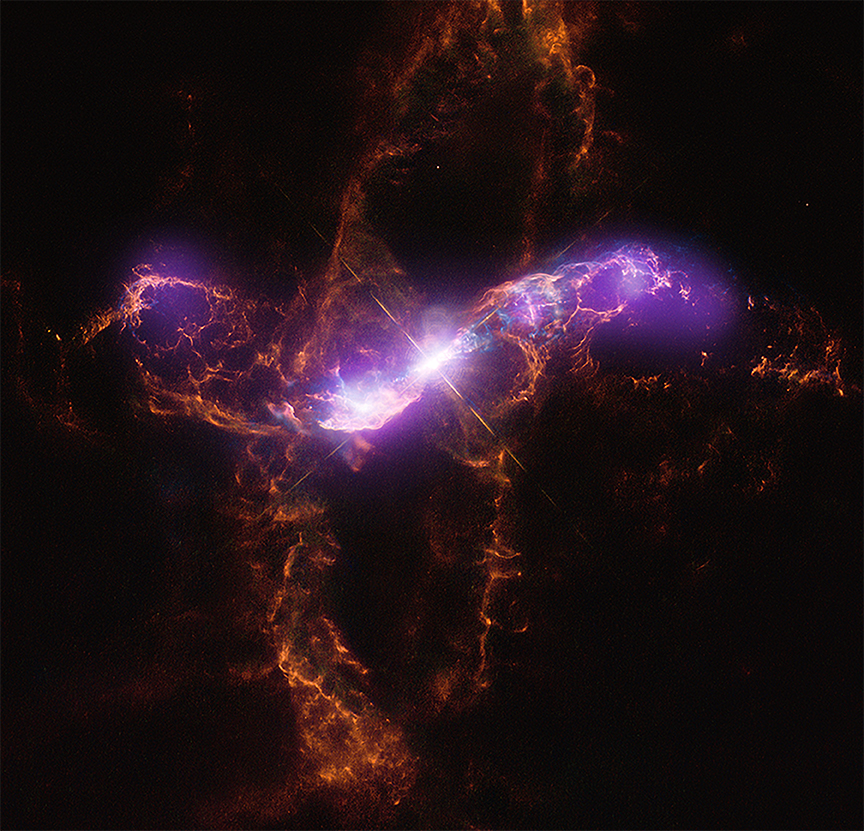
Symbiotic R Aquarii (Montez R. et al. 2022)
Think stars are solitary giants, blazing majestically in isolation? Think again! The vast majority of stars in the universe are actually locked in a cosmic dance with a partner – a binary star system (CSIRO, n.d).
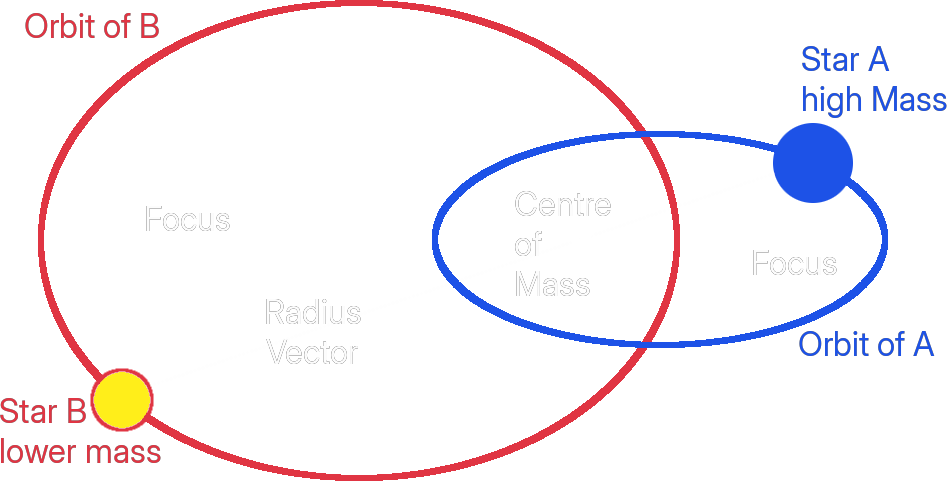
Figure 1: Orbits of stars in a binary system
Binary star systems are a captivating phenomenon in the cosmos, consisting of two stars gravitationally bound to orbit a common centre, as pictured in Figure 1. This relationship sets them apart from “double stars”, which are simply stars that appear close together in the sky but may not have any physical connection. In other words, binary stars are a subset of double stars!
These stellar pairs come in a dazzling array of configurations, offering a glimpse into the dramatic and dynamic lives of stars. This article delves into the world of binary stars, exploring their formation, evolution, and the various types that grace the night sky. We will also train our sights on the remarkable R Aquarii system, a symbiotic binary that exemplifies the fascinating interplay between stellar companions.
Binary Stars 101
Now we have a general idea of what binary star systems are – cosmic tandems, consisting of two stars bound together by gravity, orbiting each other through space. We also know that these systems are incredibly common, comprising a significant portion of the stellar population in our galaxy and beyond. But how do they form?
The truth is, astronomers are still piecing together the exact story, but there are two main ideas floating around, which are discussed in detail by Offner et. al. (2022):
- Turbulent Fragmentation: Picture a giant cloud of dust and gas collapsing inwards under its own gravity. This collapse can be a bit messy, breaking the cloud up into swirling disks. These disks then condense and ignite, forming a brand new binary system.
- Disk Fragmentation: A young star might be surrounded by a swirling disk of gas and dust. This disk itself can get wobbly and break into two separate disks, which then collapse to form two stars.
The same researchers are looking at the alignment of jets from these stars – powerful streams of gas and dust young stars shoot out – to see if they can crack the code on which formation story is the right one.
Binary star systems can be broadly classified based on how they are detected (Heintz 1978, pg 1-3). Visual binary stars are those that can be directly observed as two separate stars using high-powered telescopes. Spectroscopic binaries, on the other hand, cannot be visually separated but instead reveal their binary nature through the periodic Doppler shift of their spectral lines. You can imagine the “spectrum” of a star as a sort of fingerprint of light, and when binary stars orbit each other, their spectra appear to shift, like their light is being stretched and squished. This kind of periodic shifting tells us they're a binary!
Eclipsing (aka Photometric) binary stars are a special class of spectroscopic binaries where the orbital plane of the system is aligned nearly edge-on with our line of sight. As the stars spin around their common centre, one star may periodically pass in front of the other, causing a temporary dip in the combined brightness of the system. These eclipses provide invaluable information about the stars' sizes, shapes, and orbital parameters.
Astrometric binaries are those for which the gravitational wobble of one star due to the unseen companion can be measured with high-precision instruments (Commonwealth Scientific and Industrial Research Organisation, n.d). This wobble, though slight, can be used to infer the presence and mass of the unseen companion star.
Beyond these basic classifications, binary star systems can also be categorised based on their orbital separation and the evolutionary states of their constituent stars (Heintz 1989, pg 96). Detached binaries have a wide separation, with little to no interaction between the stars. Semi Detached binaries, like R Aquarii, are those in which the stars are close enough for mass transfer to occur from one star to the other. Contact binaries are even closer, with their outer layers actually touching and forming a common envelope, somewhat similar in shape to a peanut (Heintz 1989, pg 96)!
The designations of the individual stars within a binary system typically follow a letter system. The primary star, the one that is typically brighter, is designated as A. The secondary star is then designated as B, and any additional stars are denoted by subsequent letters (Heintz 1989, pg 19).
The R Aquarii System
Now that we’re familiar with binary stars, let's enter R Aquarii, a captivating example of a symbiotic binary system. This stellar duo, pictured at the start of this article (Montez R. et al. 2022), consists of a red giant star (R Aquarii A), and a hot, white dwarf (R Aquarii B) – a feisty little companion. The red giant, once a luminous giant in its own right, now orbits its compact companion, sharing its outer layers through a process known as mass transfer.
This mass transfer is what makes R Aquarii so captivating. The red giant's immense size and lower gravity make it vulnerable to the white dwarf's powerful gravity. As a result, the white dwarf syphons off hydrogen-rich gas from its companion. This stolen bounty accumulates on the surface of the white dwarf, gradually increasing its mass.
As the red dwarf continues to shave off material, the stolen hydrogen eventually reaches a critical mass on the surface of the white dwarf, igniting in a thermonuclear explosion known as a nova (Prialnik, D. 2001). These eruptions are colossal stellar fireworks, briefly transforming the normally faint white dwarf into a blazing star that can rival the brightness of its red giant companion (NASA, n.d).
These explosions release tremendous amounts of energy, energising the surrounding gas and creating stunning nebulae that adorn the cosmic landscape. The interplay between the two stars, with mass transfer and explosive outbursts, makes R Aquarii a captivating celestial spectacle (NASA, n.d).
The thermonuclear blasts from R Aquarii B don't just brighten the stellar neighbourhood; they also play a crucial role in shaping the surrounding gas and dust. The shockwaves from the explosions carve out a cavity in the interstellar medium, and the ejected material forms intricate and colourful nebulae (Kafatos, M. and Michalitsianos, A.G 1982). Astronomers believe a nova outburst from R Aquarii B may have been observed by Japanese astronomers in the year 930 AD, hinting at the system's long history of explosive episodes (Kafatos, M. and Michalitsianos, A.G 1982).
Further study of the R Aquarii system may shed light on the complex dynamics of binary stars and the dramatic ending that awaits many stellar partnerships.
Beyond R Aquarii
While R Aquarii offers a captivating glimpse into the world of binary stars, its significance extends far beyond its individual characteristics. Binary star systems play a crucial role in stellar evolution, influencing the formation of planetary nebulae, supernovae, and even the distribution of elements in the universe.
The interactions between binary stars can also shape the dynamics of entire galaxies, influencing their structure and evolution over cosmic timescales. By studying systems like R Aquarii, astronomers gain valuable insights into the fundamental processes driving the evolution of stars and galaxies, unravelling the mysteries of the cosmos one binary system at a time.
In conclusion, binary star systems like R Aquarii are not only celestial marvels but also windows into the complex workings of the universe. From their formation and evolution to their explosive interactions and cosmic implications, these systems continue to captivate astronomers and inspire awe in all who gaze upon them. As we continue to explore the cosmos, it is certain that binary stars will remain a cornerstone of our understanding of the vast and wondrous universe that surrounds us.